

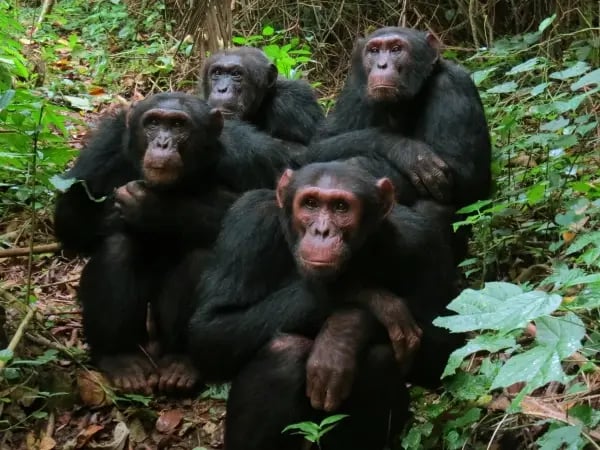
 Bulindi
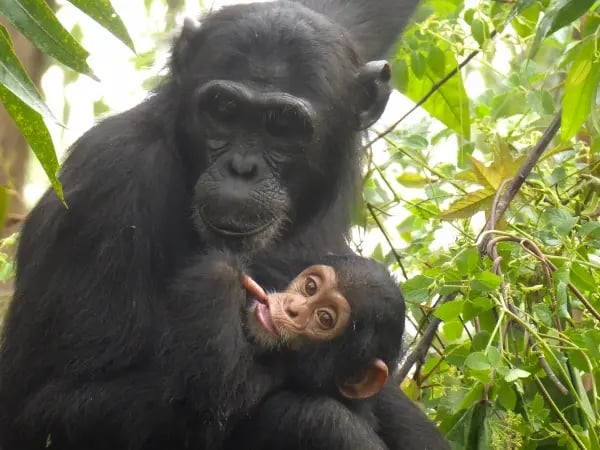 Wagaisa
.webp?width=600&height=450&name=bccp_individual%20chimp%20page%20-%20mairirwe_the%20mairirwe%20chimpanzees%20(1).webp) Mairirwe
Mairirwe
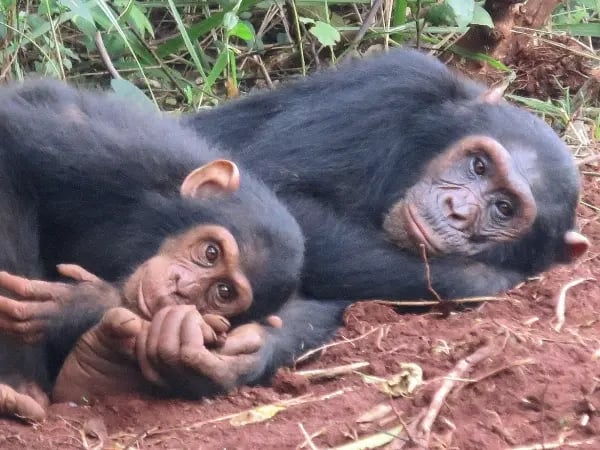 Kyabasengya
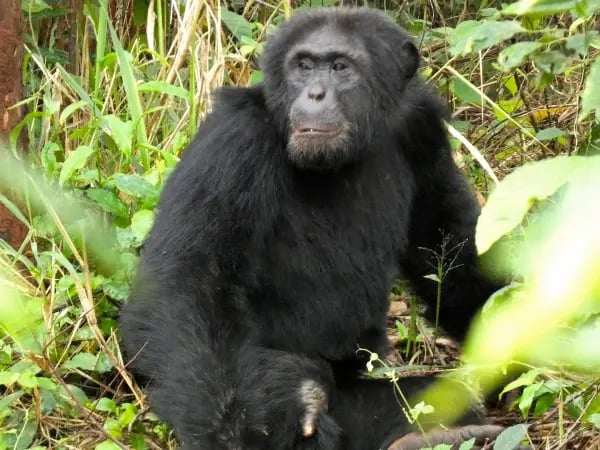 Kihomboza
.webp?width=600&height=450&name=bccp_individual%20chimp%20page%20-%20kiraira-kasunga_the%20kiraira%E2%80%93kasunga%20chimpanzees%20(1).webp) Kiraira-Kasunga
Kiraira-Kasunga
 Blogs & Updates
 Videos
 Publications
Chimpanzee Memory: The Famous Ayumu Test
In 2007, a young chimpanzee named Ayumu became an unlikely scientific celebrity after a study found he could outperform human adults on a specific short-term memory task — a genuinely surprising result that challenged assumptions about human cognitive superiority being universal across every mental skill.
What the test actually involved
Researchers at Kyoto University trained chimpanzees, including Ayumu, on a touchscreen task: numbers from 1 to 9 flashed briefly on a screen in random positions, then were covered by blank white squares. The subject had to touch the squares in the correct numerical order, purely from memory of where each number had appeared.
How Ayumu performed
Ayumu was tested with the numbers displayed for as little as 210 milliseconds — barely a fifth of a second — and still identified the correct sequence with impressive accuracy. Human adults given the same task, even after practice, generally couldn't match his speed and accuracy at these very short display times.
Why this result actually made sense to researchers
Rather than a total fluke, researchers proposed the result reflects "eidetic" or photographic-style memory capacity that may be more pronounced in young chimpanzees than in adult humans — possibly because human cognitive development trades some of this raw visual memory capacity for the capacity needed for complex language, which develops heavily during the same early childhood period.
Age mattered too
Interestingly, younger chimpanzees in the study tended to outperform older ones on this specific task, mirroring a pattern sometimes seen in young humans as well — suggesting this kind of rapid visual memory capacity may peak early in life and decline somewhat with age, in both species.
Was this a one-off, or has it been replicated?
The core finding has held up reasonably well under scrutiny, though some researchers have pointed out that direct human-chimpanzee comparisons on any cognitive task are inherently tricky — differences in motivation, prior training, and task familiarity can all affect results in ways that are hard to fully control for. Even accounting for that caveat, the basic result — that a chimpanzee can outperform trained human adults on this specific rapid memory task — has been considered a genuinely robust and influential finding in comparative cognition research.
What this does — and doesn't — tell us about chimpanzee intelligence
The Ayumu study doesn't mean chimpanzees are "smarter than humans" in any general sense — human cognition dramatically outperforms chimpanzee cognition in areas like language, abstract reasoning, and cumulative culture. What it does show is that intelligence isn't a single scale: different species can have genuinely superior performance in specific cognitive domains shaped by their own evolutionary history.
Why this matters beyond a curious headline
Findings like this have real weight in the broader case for chimpanzee conservation — they demonstrate, with hard experimental data, that chimpanzees possess genuinely sophisticated, in some ways exceptional, cognitive abilities. That's a meaningfully different picture from viewing chimpanzees as simple animals acting purely on instinct, and it reinforces why habitat loss for a species this cognitively remarkable represents a serious loss.
The connection to field conservation
Understanding chimpanzee cognition at this level of detail depends on the same kind of sustained, careful, long-term observation that underpins wild field conservation work — including the daily monitoring the Bulindi Chimpanzee & Community Project carries out with its wild community in Western Uganda, tracking behaviour and adaptation in a real, changing landscape rather than a controlled laboratory setting.
Quick FAQ
Is Ayumu still alive today? Ayumu was born in 2000 at Kyoto University's Primate Research Institute, and chimpanzees in well-cared-for research settings can live several more decades, so he may well still be alive.
Can humans train to improve at this specific task? Some improvement with practice is possible, but studies suggest even well-practised humans generally don't close the full gap seen with Ayumu's performance at the shortest display times.
Have other chimpanzees matched Ayumu's performance? Some have come close, though Ayumu remains one of the most frequently cited individual examples in the research literature on this specific memory task. Studies like this also remind us how much we still don't know about chimpanzee cognition generally, reinforcing the case for continued research and field observation rather than assuming the full picture of chimpanzee intelligence has already been mapped out.
The study remains one of the most frequently cited pieces of evidence in public discussions of animal cognition, precisely because it offers such a clear, simple, and rigorously tested demonstration that intelligence doesn't run in only one direction between species. Nearly two decades on, it remains a go-to reference point whenever the conversation turns to just how surprising, and how worth protecting, chimpanzee cognition really is. Few single experiments have travelled this far beyond their own field.
Related Reading
- Chimpanzee Culture: Do Chimps Have Traditions?
- Oldest Chimpanzee Ever Recorded
- Chimpanzee Facial Expressions
- Why Are Chimpanzees Endangered?
Meet the Real Chimps of Bulindi
BCCP monitors six wild chimpanzee communities in the Budongo–Bugoma Corridor, each with its own named members and story. Meet the chimps we protect and follow their lives.
Support the Bulindi Chimpanzee & Community Project to help protect wild chimpanzees and the remarkable cognition they represent.