

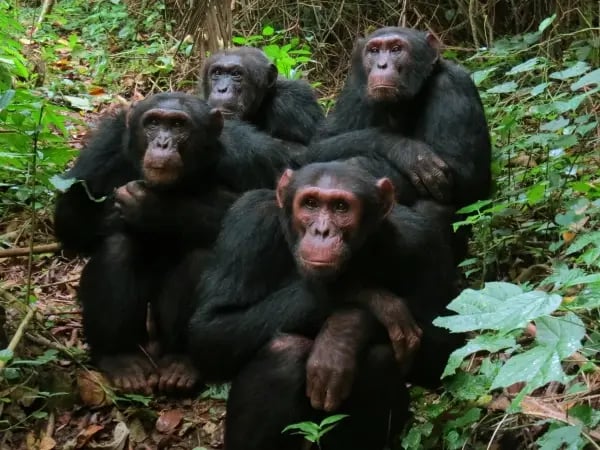
 Bulindi
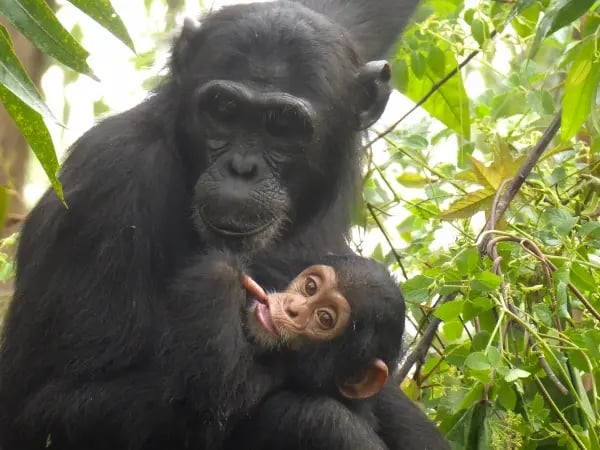 Wagaisa
.webp?width=600&height=450&name=bccp_individual%20chimp%20page%20-%20mairirwe_the%20mairirwe%20chimpanzees%20(1).webp) Mairirwe
Mairirwe
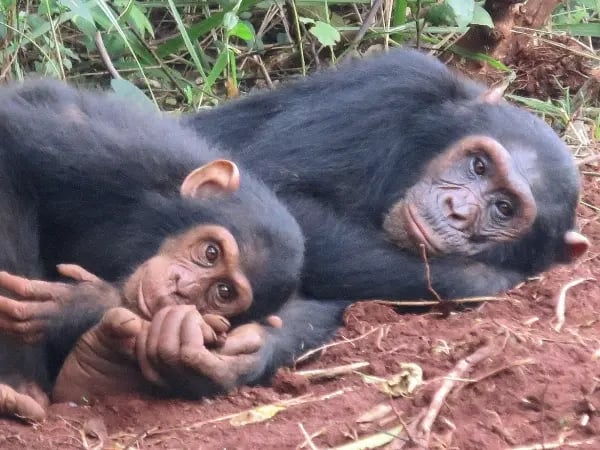 Kyabasengya
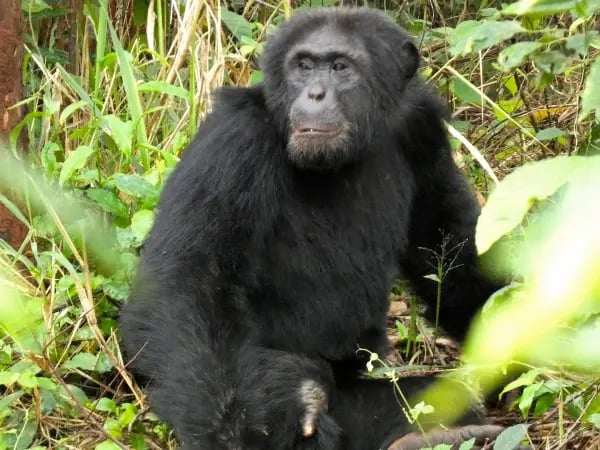 Kihomboza
.webp?width=600&height=450&name=bccp_individual%20chimp%20page%20-%20kiraira-kasunga_the%20kiraira%E2%80%93kasunga%20chimpanzees%20(1).webp) Kiraira-Kasunga
Kiraira-Kasunga
 Blogs & Updates
 Videos
 Publications
.png?width=72&height=70&name=IMG%20(1).png) Free eBook
Free eBook
Chimpanzee vs. Dolphin Intelligence
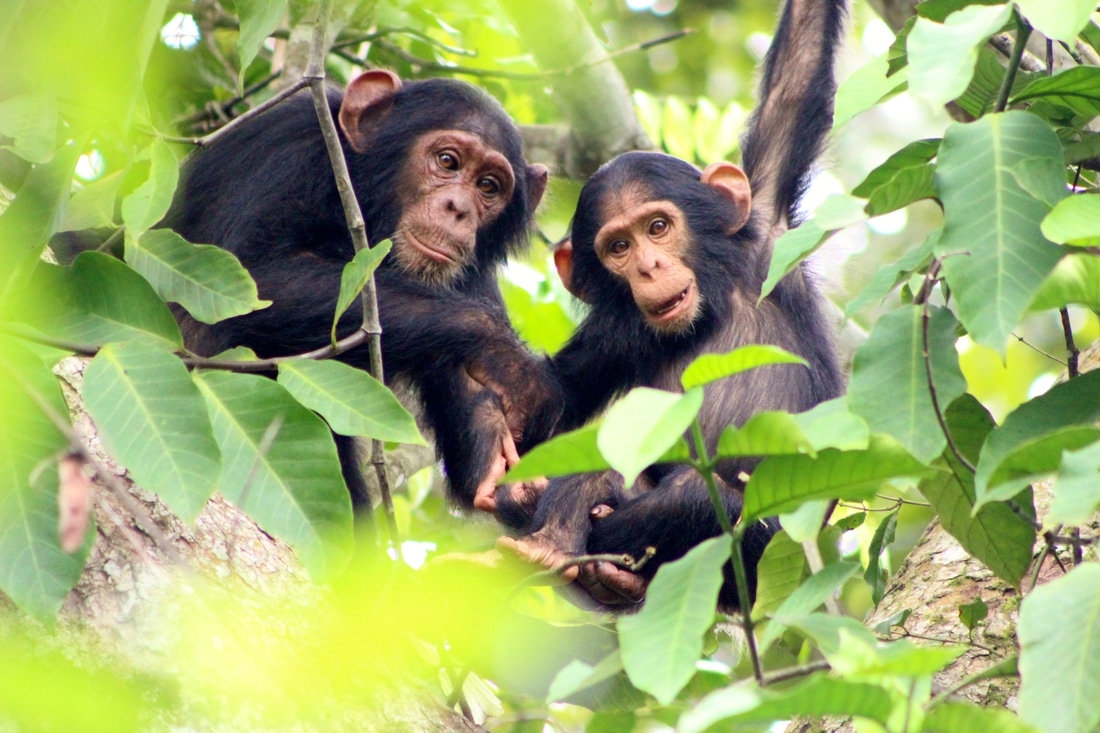
A chimpanzee cracking a nut with a stone hammer and a dolphin carrying a marine sponge on its nose to protect against sharp coral look, at first glance, like they belong to entirely different conversations about intelligence. Yet both behaviours are examples of tool use and cultural transmission — hallmarks of advanced cognition that researchers place chimpanzees and dolphins at the very top of the non-human intelligence rankings for.
Two completely different environments
Chimpanzee intelligence evolved for a terrestrial and arboreal world of trees, tools, and hand-based manipulation. Dolphin intelligence evolved entirely underwater, built around echolocation, three-dimensional spatial reasoning, and sound-based communication across open water. Because their ecological problems are so different, direct comparison is inherently tricky — but the parallels in the underlying cognitive machinery are striking.
Tool use
Chimpanzees are famous for varied, hand-based tool use: termite-fishing probes, nut-cracking stone hammers and anvils, and leaf sponges for drinking water, with distinct tool traditions passed down within specific chimpanzee communities. Dolphins, without hands, have still developed genuine tool use — the best-documented case being "sponging" in Shark Bay, Australia, where certain bottlenose dolphins carry a marine sponge on their rostrum to protect it while foraging on the seafloor, a skill passed down primarily from mother to offspring, forming a clear cultural tradition much like chimpanzee tool traditions.
Self-recognition
Both species pass the mirror self-recognition test, using a mirror to inspect a mark placed on their own body rather than reacting as though seeing another animal. Chimpanzees were among the very first non-human species shown to pass this test, and bottlenose dolphins demonstrated the same capacity in landmark studies — placing both species in an extremely short list of animals credited with this level of self-awareness, alongside elephants and a small number of birds.
Communication
Chimpanzee communication combines vocalisations, facial expressions, and an extensive repertoire of gestures, some of which appear to carry specific, learned meanings within a community. Dolphins take vocal communication further in some respects: individuals develop unique "signature whistles" that function similarly to names, allowing dolphins to identify and call specific individuals by "name" across considerable distances — a level of individual vocal labelling not clearly documented in chimpanzees.
Social structure
Chimpanzee communities are organised around fission-fusion dynamics, shifting coalitions, and, at times, serious rivalry between neighbouring groups. Dolphin pods show comparably complex social lives, including multi-level alliances between males that cooperate to gain access to females — a nested alliance structure considered among the most complex social systems documented outside of humans and great apes.
Brain size versus brain organisation
A bottlenose dolphin's brain is actually larger than a chimpanzee's relative to body size in some measures, and dolphins have a notably expanded and folded neocortex. However, the layered structure of the dolphin neocortex differs from the primate cortex, and some researchers argue that raw structural comparisons between such distantly related lineages, separated by roughly 90 million years of independent evolution, tell us less than looking at the actual behaviours each species can perform.
So which is smarter?
As with most cross-domain intelligence comparisons, there is no single meaningful winner. Chimpanzees have the edge in hand-based tool manufacture, variety of tool use, and closeness to human cognitive architecture given our shared ancestry. Dolphins have the edge in vocal individual identification and navigating complex three-dimensional, sound-based social environments. Both independently arrived at tool use, culture, and self-awareness — evidence that sophisticated cognition has evolved more than once, in very different bodies, in response to very different pressures.
Quick FAQ
Are dolphins smarter than chimpanzees? Neither is straightforwardly smarter — both rank among the most cognitively advanced non-human animals, excelling in different domains suited to their entirely different environments.
Do chimpanzees and dolphins share any evolutionary history? Only very distantly — their lineages diverged roughly 90 million years ago, making any similarities in intelligence a case of convergent evolution rather than shared ancestry.
What's the strongest evidence either species is genuinely self-aware? Passing the mirror self-recognition test is considered strong evidence in both species, since it requires understanding that the reflection is one's own body rather than another individual.
Could a chimpanzee ever be trained to understand a dolphin's whistles, or vice versa? Not meaningfully — their communication systems evolved for entirely different sensory channels and environments, so while both species can learn simple human-taught symbol systems in captivity, there is no evidence either could naturally interpret the other's species-specific signals.
Convergent evolution, not competition
Perhaps the most valuable takeaway from comparing chimpanzees and dolphins isn't which species comes out ahead, but what their shared traits reveal about intelligence itself. Tool use, self-recognition, and culture have each evolved independently in a land-based ape and a fully aquatic mammal separated by tens of millions of years — strong evidence that advanced cognition isn't a fluke restricted to primates, but something evolution has arrived at more than once whenever social complexity and environmental problem-solving demand it.
Related Reading
- Chimpanzee vs. Elephant Intelligence: Comparing Animal Smarts
- Primate vs. Other Mammal Intelligence: Where Do Apes Rank?
- Orangutan vs. Chimpanzee Intelligence
Meet the Real Chimps of Bulindi
BCCP monitors six wild chimpanzee communities in the Budongo–Bugoma Corridor, each with its own named members and story. Meet the chimps we protect and follow their lives.
Want to make a difference and support our conservation efforts? Donate today