

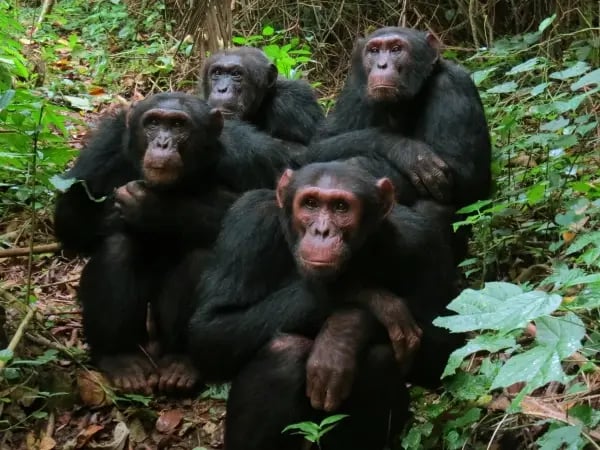
 Bulindi
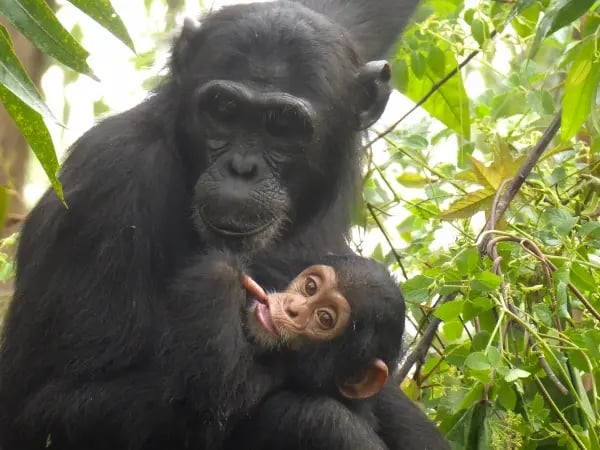 Wagaisa
.webp?width=600&height=450&name=bccp_individual%20chimp%20page%20-%20mairirwe_the%20mairirwe%20chimpanzees%20(1).webp) Mairirwe
Mairirwe
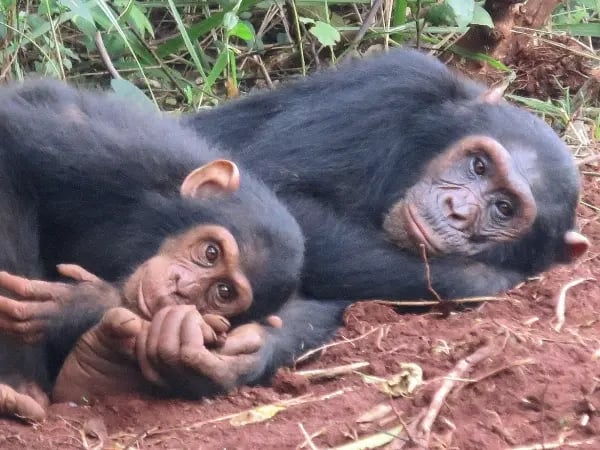 Kyabasengya
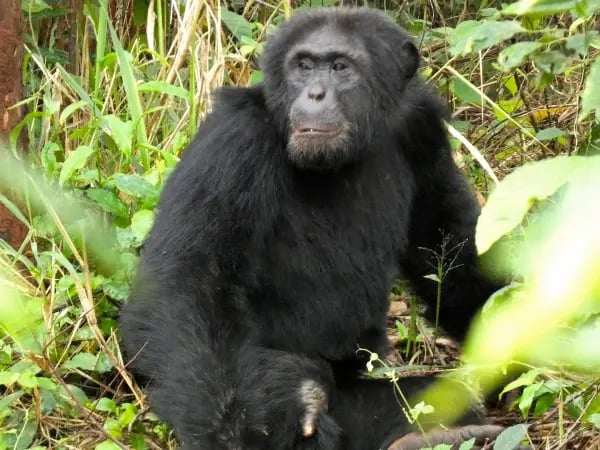 Kihomboza
.webp?width=600&height=450&name=bccp_individual%20chimp%20page%20-%20kiraira-kasunga_the%20kiraira%E2%80%93kasunga%20chimpanzees%20(1).webp) Kiraira-Kasunga
Kiraira-Kasunga
 Blogs & Updates
 Videos
 Publications
.png?width=72&height=70&name=IMG%20(1).png) Free eBook
Free eBook
Chimpanzee vs. Baboon: How Do They Differ?
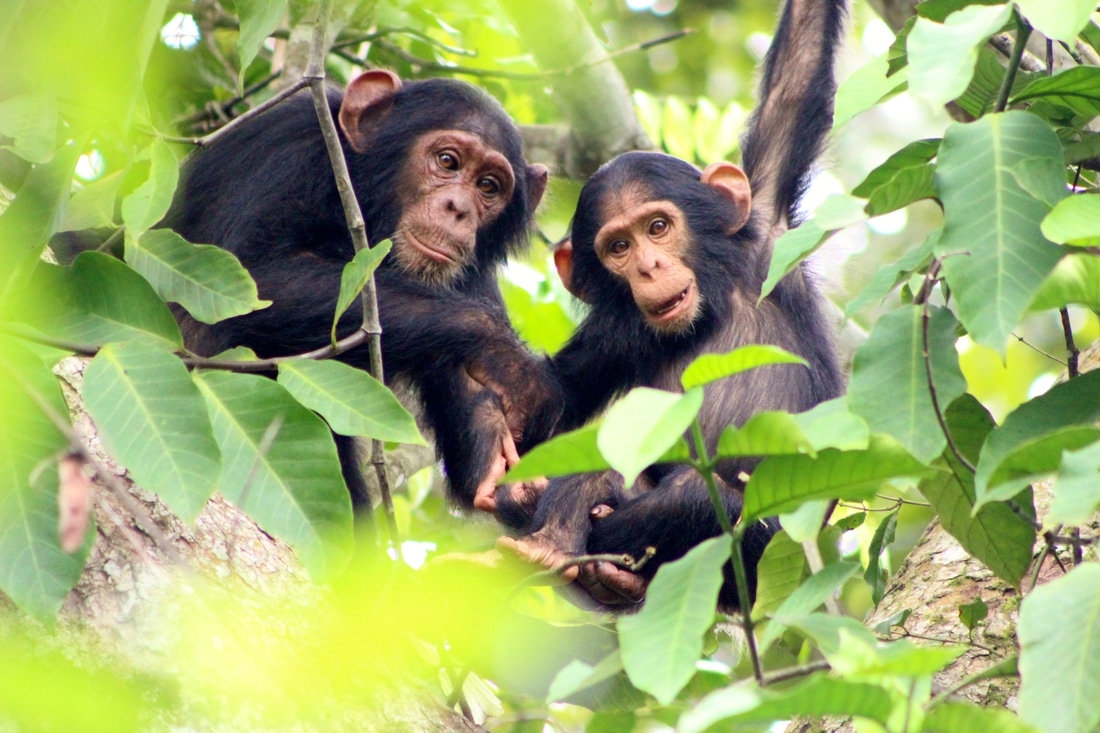
Chimpanzees and baboons both live across sub-Saharan Africa, both travel in noisy, sociable groups, and both are frequently lumped together in the popular imagination as "monkeys in the jungle." In reality, they belong to entirely different branches of the primate family tree, and the differences between them go far beyond the obvious.
Ape versus monkey: the first distinction
The single clearest difference is also the easiest to spot: baboons have tails, chimpanzees do not. Baboons (genus Papio) are Old World monkeys, while chimpanzees belong to the great apes, the family that also includes gorillas, orangutans, bonobos, and humans. Apes and monkeys split from a common ancestor roughly 25–30 million years ago, and that tail is one of the most reliable visual markers separating the two groups ever since.
Body and movement
Baboons are quadrupedal specialists, walking on all fours with a flat-backed, dog-like gait built for covering long distances across open savanna and woodland. Chimpanzees knuckle-walk on the ground but are also accomplished climbers, spending a significant part of each day moving through trees to feed, nest, and escape danger. An adult male chimpanzee typically weighs 40–70kg, while the largest baboon species, the chacma and olive baboons, can reach 25–45kg for males — chimps are generally the bulkier, more powerfully built of the two.
Diet and foraging
Both species are opportunistic omnivores, but their emphasis differs. Chimpanzees rely heavily on ripe fruit, supplemented with leaves, seeds, insects, and occasional meat obtained through cooperative hunting of smaller mammals, including other primates. Baboons are even more opportunistic, eating grasses, roots, seeds, insects, small vertebrates, and, notoriously, raiding crops and rubbish when the chance arises — a trait that, like chimpanzees, brings them into frequent conflict with farming communities across their range.
Social structure
Baboon troops can number anywhere from a handful to over a hundred individuals, organised around strict, largely stable dominance hierarchies among both males and females. Chimpanzee communities use a "fission-fusion" system instead — a larger community splits into smaller, shifting subgroups throughout the day, and alliances between individuals are more fluid, political, and, at times, more volatile than the comparatively rigid baboon hierarchy.
Tool use and intelligence
This is where the gap widens considerably. Chimpanzees are among the most prolific tool-users in the animal kingdom, fashioning sticks to fish for termites, using stone hammers and anvils to crack nuts, and even sharpening sticks to hunt small prey in some populations. Baboons show comparatively little tool use in the wild. Chimpanzee brains are also proportionally larger relative to body size, supporting the more complex problem-solving, planning, and social strategy that chimpanzee researchers have documented for decades.
Lifespan and reproduction
Chimpanzees are considerably longer-lived, typically reaching 33–45 years in the wild and 50–60 years in protected or captive settings. Baboons have a faster life history, generally living 20–30 years, reflecting their smaller body size and different ecological pressures. Chimpanzees also have a much longer childhood, nursing offspring for up to five years and keeping them dependent for learning tool skills and social behaviour well into adolescence.
Conservation status
The conservation picture is starkly different, too. Most baboon species are listed as Least Concern, with large, stable, and in some areas expanding populations thanks to their adaptability and tolerance of human-modified landscapes. Chimpanzees, by contrast, are classified as Endangered across their entire range, squeezed by habitat loss, poaching, and disease as forests are cleared for agriculture. In the Budongo–Bugoma Corridor where BCCP works, both species share fragmented forest patches, but only the chimpanzees face the kind of population decline that puts their long-term survival genuinely at risk.
Why this comparison matters
Understanding the gap between an adaptable, thriving monkey and an endangered, highly specialised great ape helps explain why conservation strategies can't be one-size-fits-all. Baboons' flexibility lets them cope with a shrinking, human-dominated landscape in a way chimpanzees simply cannot — which is exactly why targeted, species-specific interventions like forest corridor replanting and community conflict reduction are so essential for chimpanzee survival, even in areas where baboon numbers look perfectly healthy.
Quick FAQ
Do chimpanzees and baboons ever interact in the wild? Yes — in areas of overlapping range, including parts of Uganda, the two species can be found in the same forest fragments, occasionally competing for fruiting trees, though direct conflict between them is uncommon.
Which is more dangerous to humans? Both can raid crops and act defensively if threatened, but chimpanzees are considerably stronger and, in rare cases, have caused serious injuries; baboon troops are more commonly a nuisance through crop-raiding and bin-raiding than genuine danger.
Are baboons closely related to chimpanzees? Not especially — despite superficial similarities, baboons and chimpanzees diverged from a shared ancestor around 25–30 million years ago, making baboons far more distantly related to chimpanzees than chimpanzees are to humans.
Related Reading
- Primate vs. Other Mammal Intelligence: Where Do Apes Rank?
- Great Ape Brain Size Compared: Chimp, Gorilla, Orangutan, Bonobo
- Apes vs. Monkeys: What's the Real Difference?
Meet the Real Chimps of Bulindi
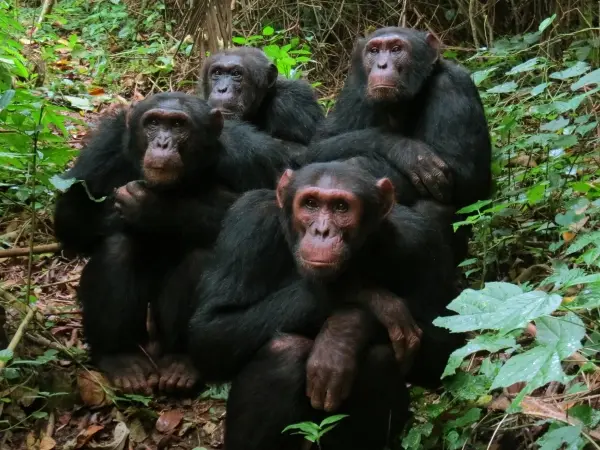
BCCP monitors six wild chimpanzee communities in the Budongo–Bugoma Corridor, each with its own named members and story. Meet the chimps we protect and follow their lives.
Want to make a difference and support our conservation efforts? Donate today