
 Bulindi
 Wagaisa
.webp?width=600&height=450&name=bccp_individual%20chimp%20page%20-%20mairirwe_the%20mairirwe%20chimpanzees%20(1).webp) Mairirwe
Mairirwe
 Kyabasengya
 Kihomboza
.webp?width=600&height=450&name=bccp_individual%20chimp%20page%20-%20kiraira-kasunga_the%20kiraira%E2%80%93kasunga%20chimpanzees%20(1).webp) Kiraira-Kasunga
Kiraira-Kasunga
 Blogs & Updates
 Videos
 Publications
Disease Risk From Human-Chimpanzee Contact
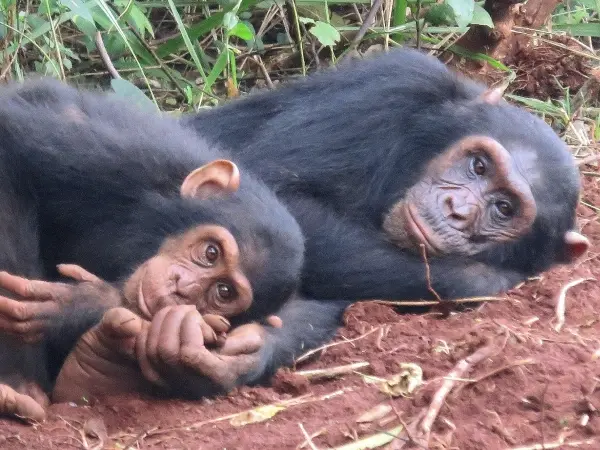
Chimpanzees' close genetic relationship to humans — sharing 98–99% of our DNA — is often framed purely as a fascinating scientific fact, but it has a serious practical downside: chimpanzees are highly susceptible to many human diseases, and as habitat shrinks and contact increases, that susceptibility becomes a genuine conservation threat.
Why chimpanzees can catch human diseases so easily
Because chimpanzee and human physiology are so closely related, many human respiratory pathogens — including common cold viruses and more serious respiratory infections — can infect chimpanzees just as readily as people. This isn't true of most wildlife; a chimpanzee's biological similarity to us is precisely what makes cross-species transmission so straightforward compared to more distantly related animals.
Documented outbreaks in wild populations
Respiratory disease outbreaks, some linked to human-origin pathogens, have caused documented population declines at several long-term chimpanzee research sites over the years. These events illustrate a real, recurring risk rather than a purely theoretical concern — a single outbreak can significantly affect a small, already fragmented community.
Why fragmented habitat increases this risk
In landscapes where chimpanzees survive in forest fragments surrounded by farmland — as in much of Western Uganda — contact with people is simply more frequent than in large, intact forest blocks with a substantial buffer between wildlife and human settlement. More contact directly increases the opportunity for disease transmission in either direction.
Tourism and research as transmission risks
Chimpanzee tourism and research both involve close human proximity that carries some degree of disease risk, which is why responsible research and tourism operations increasingly follow strict protocols — minimum distance guidelines, mask use in some contexts, and health screening for researchers and visitors — specifically designed to reduce the chance of introducing human pathogens to a wild community.
Why small populations are especially vulnerable
A disease outbreak that a larger, more genetically diverse population might absorb with manageable losses can be catastrophic for a small, isolated community — exactly the kind of population structure common in fragmented habitats like Western Uganda's forest patches. Reduced genetic diversity in small populations can also mean reduced immune resilience to a novel pathogen.
What reduces this risk in practice
Effective disease-risk management combines several elements: strict health and hygiene protocols for anyone working closely with a wild community, minimising unnecessary close contact, and — perhaps counterintuitively — actively working to reduce the forced proximity between chimpanzees and people that habitat fragmentation creates in the first place, through forest restoration and corridor reconnection.
Why daily monitoring matters for disease risk specifically
Ongoing, close observation of a chimpanzee community's health — appetite, activity levels, visible signs of illness — allows a field team to identify a potential disease event early, when intervention or at least careful tracking is still possible, rather than discovering a serious outbreak only after it has already spread significantly through the community.
Balancing necessary research with genuine risk
This is a real tension in chimpanzee field conservation: understanding a wild community well enough to protect it effectively requires some degree of human proximity, which itself carries disease risk. Programmes like the Bulindi Chimpanzee & Community Project's daily monitoring work in Western Uganda are designed with strict protocols precisely to manage this trade-off responsibly.
Quick FAQ
Can chimpanzees give diseases to humans, not just the reverse? Yes — transmission risk runs in both directions, though the specific pathogens and relative risk differ depending on the disease in question.
Do vaccinated researchers still pose a disease risk to wild chimpanzees? Vaccination reduces risk for some specific diseases but doesn't eliminate it entirely, which is why strict distance and hygiene protocols remain standard practice regardless of a researcher's own vaccination status.
Has disease ever caused a chimpanzee population to collapse? Significant declines linked to disease outbreaks have been documented at several long-term study sites, underscoring that this is a genuine, not merely theoretical, conservation risk.
Why this risk will only grow with fragmentation
As chimpanzee habitat continues to shrink and fragment across much of their range, contact with people is likely to keep increasing rather than decreasing — making disease-risk management an ongoing, ever more relevant part of chimpanzee conservation work, not a one-time protocol that can simply be set and forgotten. The COVID-19 pandemic sharpened global attention on this exact risk category, prompting many primate research and tourism sites worldwide to further tighten existing health protocols even beyond their already cautious pre-pandemic standards. Ongoing genetic and virological research into cross-species pathogen transmission continues to refine understanding of exactly which diseases pose the greatest risk in either direction, informing increasingly precise, evidence-based protocols for anyone working in close proximity to wild or habituated great ape populations.
Related Reading
- What Is a Wildlife Corridor?
- Chimpanzee Habitat Loss, By the Numbers
- The Albertine Rift: Uganda's Biodiversity Hotspot
- Apes vs. Monkeys: What's the Real Difference?
Meet the Real Chimps of Bulindi
BCCP monitors six wild chimpanzee communities in the Budongo–Bugoma Corridor, each with its own named members and story. Meet the chimps we protect and follow their lives.
Support the Bulindi Chimpanzee & Community Project to help fund this careful, ongoing field work. These refined protocols are now considered standard practice across responsible research and tourism operations working with wild or habituated great apes, reflecting lessons learned from decades of accumulated field experience.