
 Bulindi
 Wagaisa
.webp?width=600&height=450&name=bccp_individual%20chimp%20page%20-%20mairirwe_the%20mairirwe%20chimpanzees%20(1).webp) Mairirwe
Mairirwe
 Kyabasengya
 Kihomboza
.webp?width=600&height=450&name=bccp_individual%20chimp%20page%20-%20kiraira-kasunga_the%20kiraira%E2%80%93kasunga%20chimpanzees%20(1).webp) Kiraira-Kasunga
Kiraira-Kasunga
 Blogs & Updates
 Videos
 Publications
Inside a Chimpanzee Community: Social Structure Explained
Chimpanzee society is built around a structure known as "fission-fusion" — a large community, sometimes upwards of 100 individuals, that constantly splits into smaller subgroups and reforms throughout the day, rather than moving together as a single fixed unit. It's a flexible, adaptive system, and it's central to understanding how chimpanzees actually live.
Fission-fusion in practice
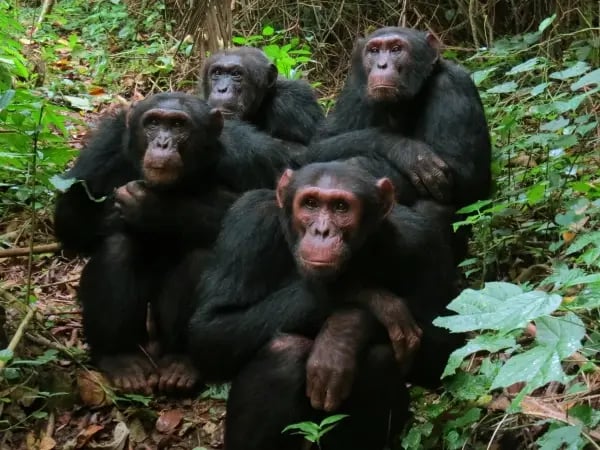
On any given day, a chimpanzee community might split into a foraging party of five, a resting group of mothers and infants, and a pair of young males exploring the territory's edge — all belonging to the same overall community, but rarely all together at once. This flexibility lets chimpanzees adjust group size to food availability: smaller parties when fruit is scarce and spread thin, larger gatherings when a big food source can support many individuals at once.
Rank and hierarchy
Chimpanzee communities are typically organised around a male dominance hierarchy, topped by an alpha male whose position is maintained through a mix of physical strength, political alliances, and social intelligence rather than size alone. Lower-ranking males show submission to higher-ranking ones through pant-grunts and body posture, and rank can shift over months or years as coalitions form and break down. Female hierarchies exist too, generally quieter and more stable, often tied to age and the strength of an individual female's social relationships.
Alliances and friendships
Male chimpanzees frequently form long-term political alliances — two lower-ranking males backing each other to challenge or unseat a dominant individual, for instance — and these bonds can last for years. Genuine friendships, marked by preferential grooming, shared food, and mutual support in conflict, are well documented among both males and females, and some bonds persist for the animal's entire life.
Grooming: the social glue
Grooming is arguably the single most important social behaviour in chimpanzee life. Beyond its hygienic function of removing parasites and debris, grooming reinforces alliances, calms tension after conflict, and reassures anxious or subordinate individuals. High-ranking individuals are often groomed more frequently, a visible marker of their social standing within the group.
Mothers, infants, and long childhoods
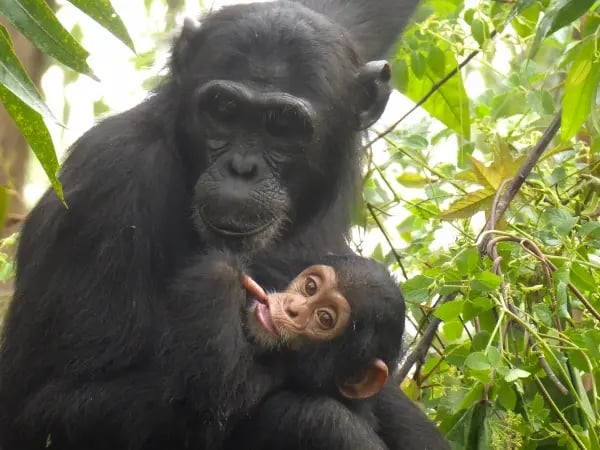
A chimpanzee mother typically nurses and carries her infant for four to five years, and the mother-offspring bond frequently continues well beyond that, sometimes for the individual's entire life. Young chimpanzees learn almost everything — tool use, foraging skills, social norms — by closely watching their mothers and other adults over this extended childhood, much longer than most mammals.
Do males or females hold more influence?
The honest answer is both, in different ways. Male rank determines a lot of visible, day-to-day social order — access to preferred food, priority in disputes, mating opportunities — and is actively contested through alliances and displays. But female chimpanzees hold real, if quieter, influence: high-ranking females often occupy the best feeding areas, tend to have more surviving offspring, and can shape group cohesion through their own social networks. Some researchers argue female social strategy is simply less visible to observers because it plays out through longer-term relationship-building rather than dramatic public contests for rank.
Territory and neighbouring communities
A chimpanzee community defends a home range against neighbouring communities, with adult males patrolling the boundaries and sometimes engaging in serious, occasionally lethal, conflict over territory. This territorial pressure is compounded in fragmented landscapes: a community confined to a small forest patch has less room to expand or shift its range in response to changing food availability, and boundary disputes with neighbouring groups — or simply running out of safe space — become correspondingly higher stakes.
Why "community" is the right word
The name Bulindi Chimpanzee & Community Project reflects a real parallel: chimpanzee society and the human communities living alongside them in Western Uganda are both organised around shared space, mutual dependence, and long-term relationships that require ongoing investment to stay healthy. The project's approach — supporting local livelihoods through education sponsorship, household projects, and clean water access, alongside forest conservation — recognises that protecting one chimpanzee community means understanding and supporting the human community it shares a landscape with, not treating the two as separate problems.
How young chimpanzees learn their place
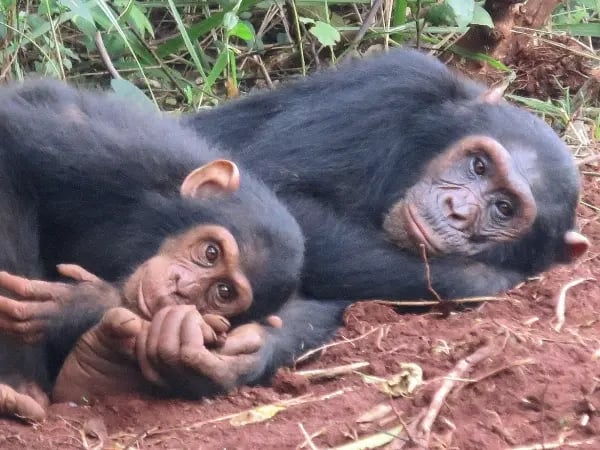
Social rank and behaviour aren't innate — they're learned over a long childhood spent closely observing adults. Juvenile males often spend years testing boundaries through play-fighting and mock displays before entering serious rank competition as adults, while young females typically stay closer to their mothers, absorbing social strategy through direct observation. This extended learning period is part of why habitat stability matters so much: a community under constant stress from habitat loss or conflict has less opportunity to pass on stable social knowledge to its next generation. Disruption to that learning process — through habitat loss, conflict, or the loss of key adults from a community — can have effects on social stability that persist for years afterward, well beyond any single incident.
Related Reading
- What Do Chimpanzees Eat? A Complete Guide
- Chimpanzee IQ: How Scientists Test Ape Intelligence
- Chimpanzee Diet in the Wild
- Apes vs. Monkeys: What's the Real Difference?
Meet the Real Chimps of Bulindi
BCCP monitors six wild chimpanzee communities in the Budongo–Bugoma Corridor, each with its own named members and story. Meet the chimps we protect and follow their lives.
Interested in supporting both? Support the Bulindi Chimpanzee & Community Project.