
 Bulindi
 Wagaisa
.webp?width=600&height=450&name=bccp_individual%20chimp%20page%20-%20mairirwe_the%20mairirwe%20chimpanzees%20(1).webp) Mairirwe
Mairirwe
 Kyabasengya
 Kihomboza
.webp?width=600&height=450&name=bccp_individual%20chimp%20page%20-%20kiraira-kasunga_the%20kiraira%E2%80%93kasunga%20chimpanzees%20(1).webp) Kiraira-Kasunga
Kiraira-Kasunga
 Blogs & Updates
 Videos
 Publications
Chimpanzee IQ: How Scientists Test Ape Intelligence
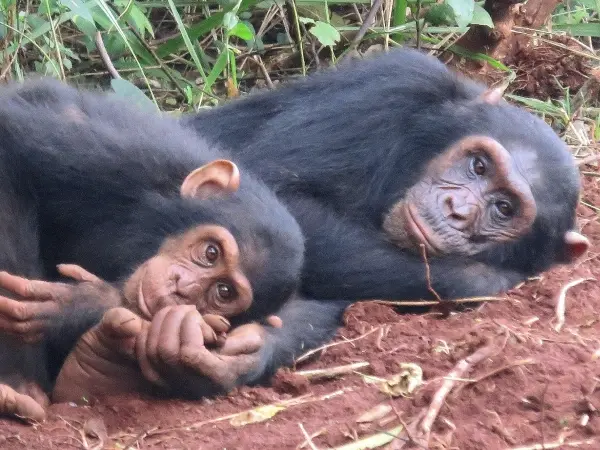
Chimpanzees obviously can't sit a standard human IQ test, so how do researchers actually measure — and compare — chimpanzee intelligence? The answer involves a range of specialised, carefully designed tasks built around what chimpanzees can naturally express.
There's no single "chimpanzee IQ score"
Unlike the standardised human IQ tests, there's no single universally agreed number for chimpanzee intelligence. Instead, researchers use a range of task-based tests targeting specific cognitive abilities — memory, problem-solving, tool use, social understanding, and self-awareness — and build up a picture from results across many tasks and many individuals.
Memory tests
One of the most striking findings in ape cognition research involves working memory. In some touchscreen-based number-sequence tasks, young chimpanzees have outperformed human adults at briefly memorising the position of numbers flashed on a screen — a genuinely surprising result that challenged assumptions about human cognitive superiority in every domain.
Problem-solving and tool tasks
Researchers commonly present chimpanzees with a food reward that requires a tool to reach — food inside a tube too narrow to reach by hand, for instance. How quickly a chimpanzee identifies the right tool, modifies it if needed, and solves the problem gives researchers a measurable, comparable indicator of problem-solving ability across individuals and even across different wild communities.
Self-awareness: the mirror test
Chimpanzees are one of a small number of species that reliably pass the mirror self-recognition test — touching a mark on their own face that they can only see in a mirror, indicating they understand the reflection is themselves rather than another individual. This is considered a marker of a certain level of self-awareness, and chimpanzees consistently demonstrate it.
Social cognition tests
Because chimpanzees live in complex, competitive social groups, researchers also test social intelligence directly — for instance, whether a chimpanzee can track which group members have seen a hidden piece of food and adjust its own behaviour accordingly to avoid a dominant individual taking it. These tests reveal a level of strategic social reasoning that goes well beyond simple instinct.
Language and symbol studies
In controlled research settings, chimpanzees have been taught to use symbol boards or sign language to request items, answer simple questions, and in some cases combine symbols in novel ways. These studies don't show chimpanzees have full human-like language, but they demonstrate a genuine capacity for referential, intentional communication beyond simple instinctive signalling.
Why this research matters for conservation
Recognising just how cognitively sophisticated chimpanzees are — capable of planning, strategic social reasoning, and genuine self-awareness — reinforces why their conservation matters beyond simple biodiversity accounting. It also has direct field relevance: understanding a specific wild community's cognitive and behavioural patterns, like the ones the Bulindi Chimpanzee & Community Project observes daily in Western Uganda, helps researchers interpret how that community is adapting — or struggling to adapt — to a changing, human-shared landscape.
The bottom line
Chimpanzee intelligence isn't measured by a single test or score — it's built from a wide, careful body of research spanning memory, tool use, self-awareness, social reasoning, and communication. Across nearly every one of these domains, chimpanzees consistently demonstrate cognitive abilities that place them among the most intelligent non-human animals we know of.
Quick FAQ
Can chimpanzees really beat humans on memory tests? In specific short-term visual memory tasks, yes — some studies have shown young chimpanzees outperforming human adults, though this doesn't mean chimpanzees are "smarter overall" across every cognitive domain.
Do all chimpanzees perform equally well on these tests? No — individual chimpanzees vary in performance just as humans do, and factors like age, upbringing, and prior exposure to similar tasks all influence results.
Are these tests conducted on wild chimpanzees? Most controlled cognitive testing happens with captive or sanctuary chimpanzees, since precise, repeatable testing conditions aren't practical in the wild; wild research instead focuses on observing natural problem-solving and tool use directly.
Why cognition research still matters for field conservation
Findings from controlled cognitive research help field conservationists interpret wild behaviour more accurately — understanding that a chimpanzee community's response to a new hazard, like a road cutting through its territory, reflects genuine problem-solving and learning, not simple chance or instinct alone. Some of this research has also proven controversial within the scientific community itself, with ongoing debate about how fairly certain tasks compare chimpanzee and human performance, given the very different sensory and motivational contexts each species brings to a laboratory setting. Funding for this kind of rigorous cognitive research has become harder to secure in recent years as conservation budgets increasingly prioritise direct habitat protection, meaning much of what's understood today may represent the most complete picture available for some time without significant new investment in comparative cognition studies specifically.
Related Reading
- Chimpanzee Diet in the Wild
- How Smart Are Chimpanzees, Really?
- Chimpanzee Aggression: Causes and Context
- Apes vs. Monkeys: What's the Real Difference?
Meet the Real Chimps of Bulindi
BCCP monitors six wild chimpanzee communities in the Budongo–Bugoma Corridor, each with its own named members and story. Meet the chimps we protect and follow their lives.
Support the Bulindi Chimpanzee & Community Project to help protect this remarkable species and the habitat it depends on.